Learning Robust Global-Local Representation from EEG for Neural Epilepsy Detection

IEEE Transactions on Artificial Intelligence (TAI)

Xinliang Zhou1,  Chenyu Liu1, Ruizhi Yang2,   Liangwei Zhang3,  Liming Zhai4, Ziyu Jia5, Yang Liu1* 
1School of Computer Science and Engineering, Nanyang Technological University, Singapore,
2School of Electronic Engineering and Computer Science, Queen Mary Univeristy of London, London, UK,
3School of Computer Science, Carnegie Mellon University, Pittsburgh, The United States,
4School of Computer Science, Central China Normal University, Wuhan, China,
5Brainnetome Center, Institute of Automation, Chinese Academy of Sciences, Beijing, China
Code | Video | Paper | Poster
Overview framwork

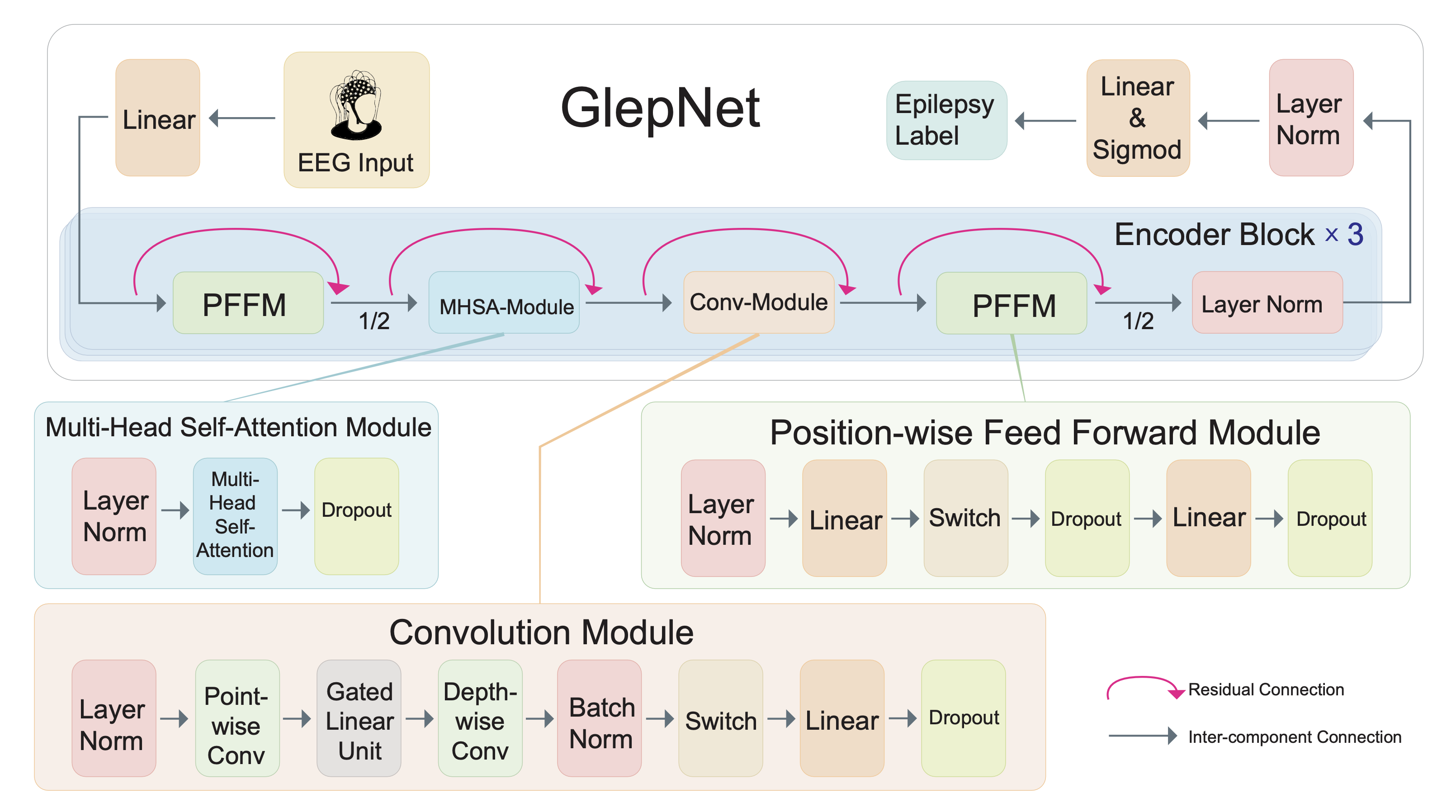
Fig. 1 Framework

Global-Local Neural Epilepsy Detection Network Architecture is shown in Fig. 1. GlepNet incorporates a linear layer for feature embedding, followed by specialized encoder blocks that enhance the detection of global-local epilepsy patterns. Each encoder block includes multi-head self-attention and convolution modules, positioned between two macaroon-like, position-wise feed-forward layers with a half-step residual connection designed to capture interleaved EEG epilepsy features effectively. A normalization layer addresses the gradient vanishing issue, while the final linear and sigmoid layers are dedicated to accurate epilepsy detection.
Experiment Result
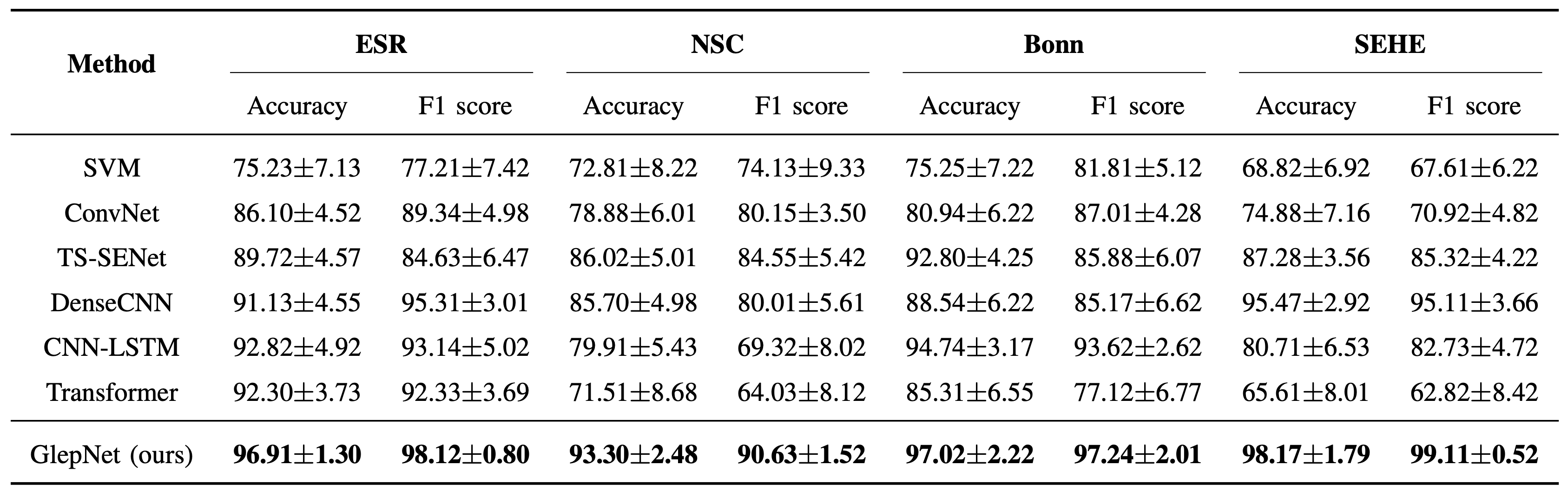
Table. 1 Comparison results.
In Table 1, we evaluate the performance and robustness of our proposed GlepNet alongside six baseline models across four datasets. Overall, GlepNet consistently outperforms the baseline models on these datasets, demonstrating significant advantages in terms of accuracy and robustness.
Table. 2 Comparison results.
In Table 2, ablation study (Accuracy in \%) is examined on four Epilepsy Datasets. "Conv-" means removing the convolution modules from the proposed GlepNet model, whereas "MHSA-" means eliminating Multi-Head Self-Attention modules from GlepNet. The best and highest results are in bold.
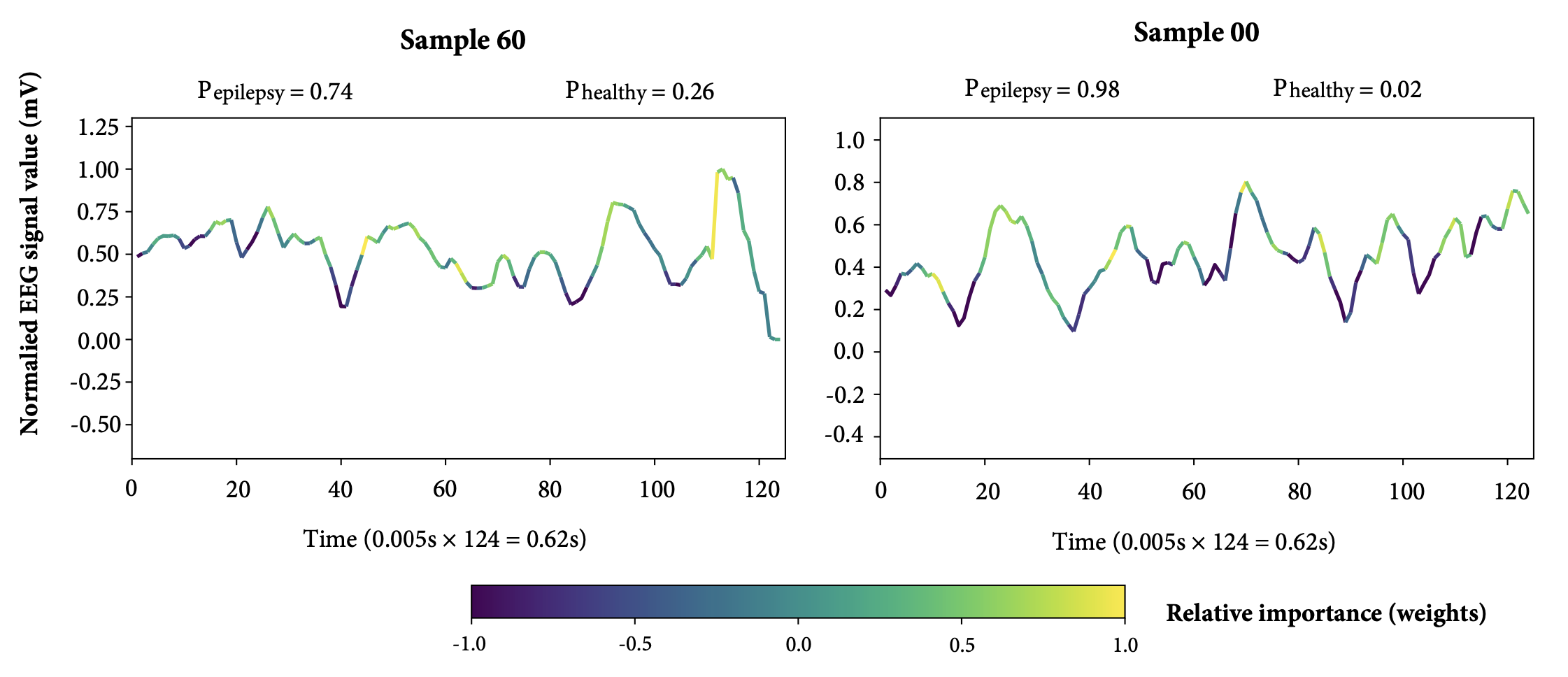
Fig. 2 Interpretable visualization.
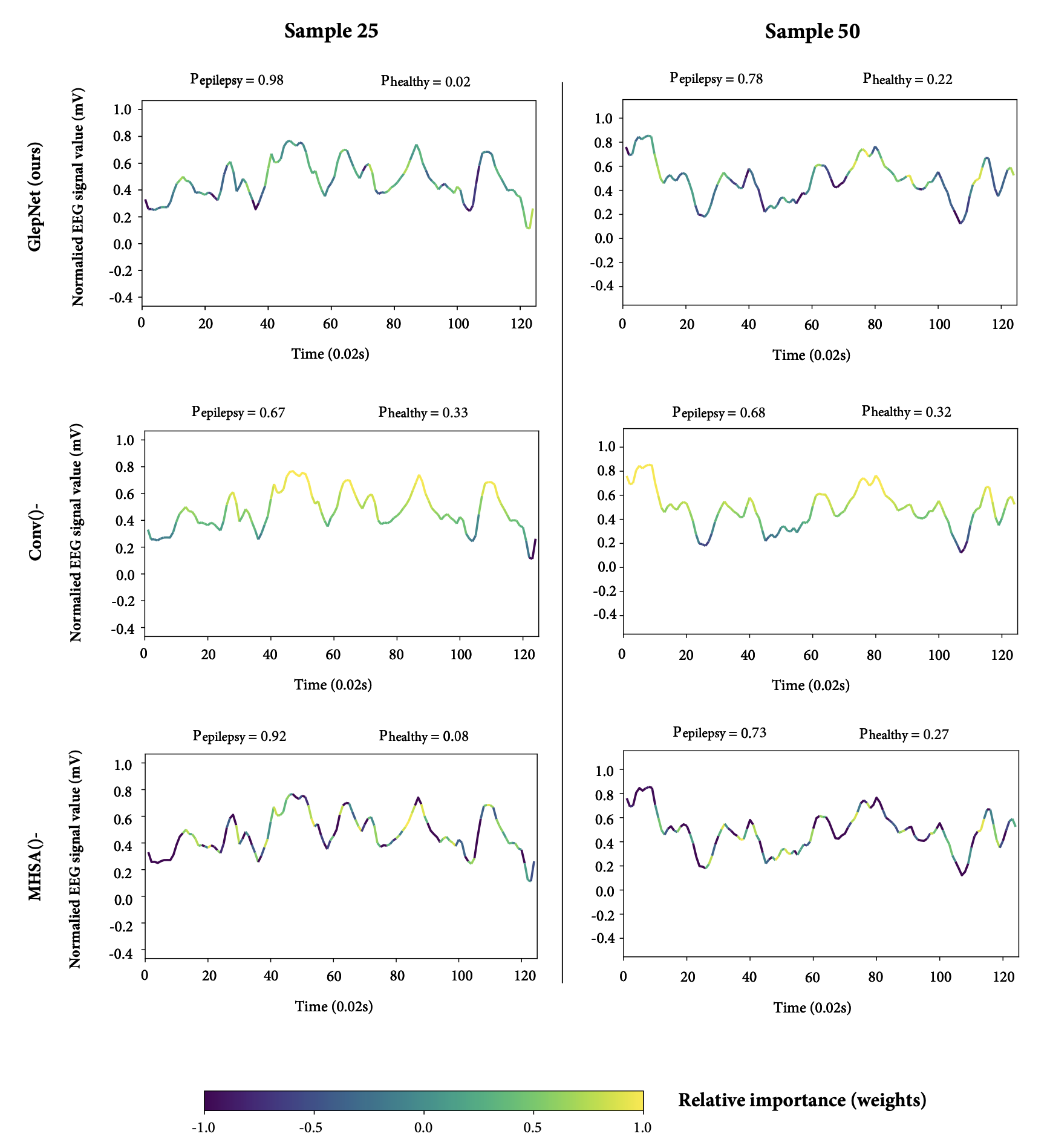
In Fig. 2 and Fig. 3, to investigate and analysis the features learned by our model, we conduct our experiment on the dataset of EEG Epilepsy Datasets from NSC via Gradient-weighted Class Activation Mapping (Grad-CAM).
Fig. 3 Interpretable visualization.
Reference


        @article{zhou2024learning,
            title        = {Learning Robust Global-Local Representation from EEG for Neural
                            Epilepsy Detection},
            author       = {Zhou, Xinliang and Liu, Chenyu and Yang, Ruizhi and Zhang, Liangwei
                            and Zhai, Liming and Jia, Ziyu and Liu, Yang},
            journal      = {IEEE Transactions on Artificial Intelligence},
            year         = {2024},
            publisher    = {IEEE}
        }